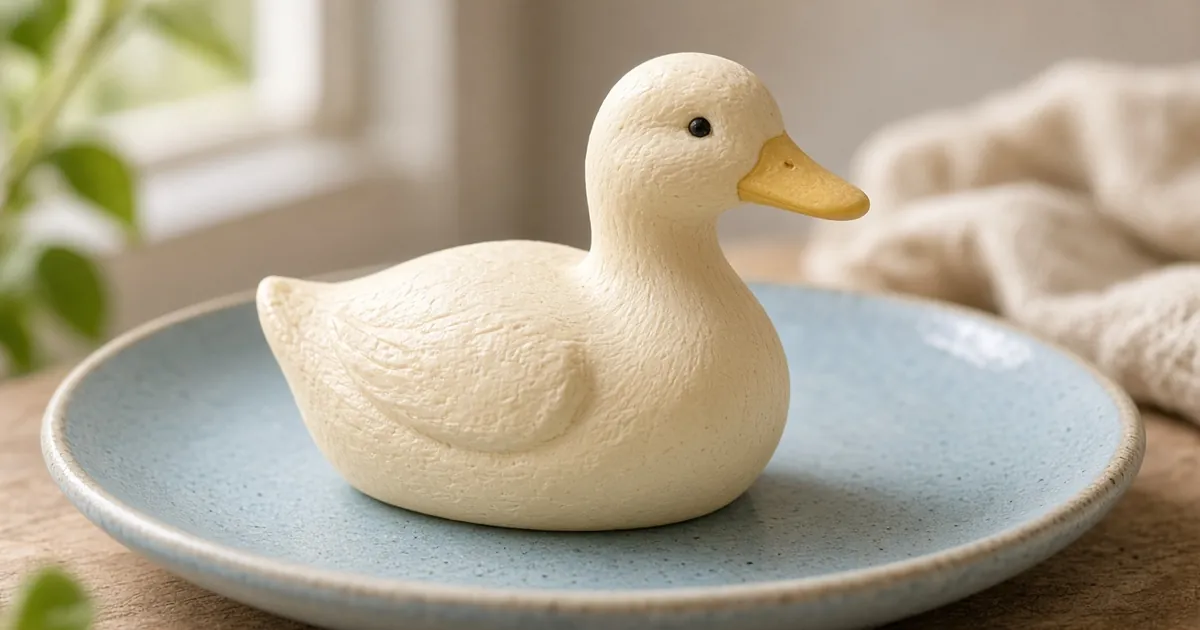
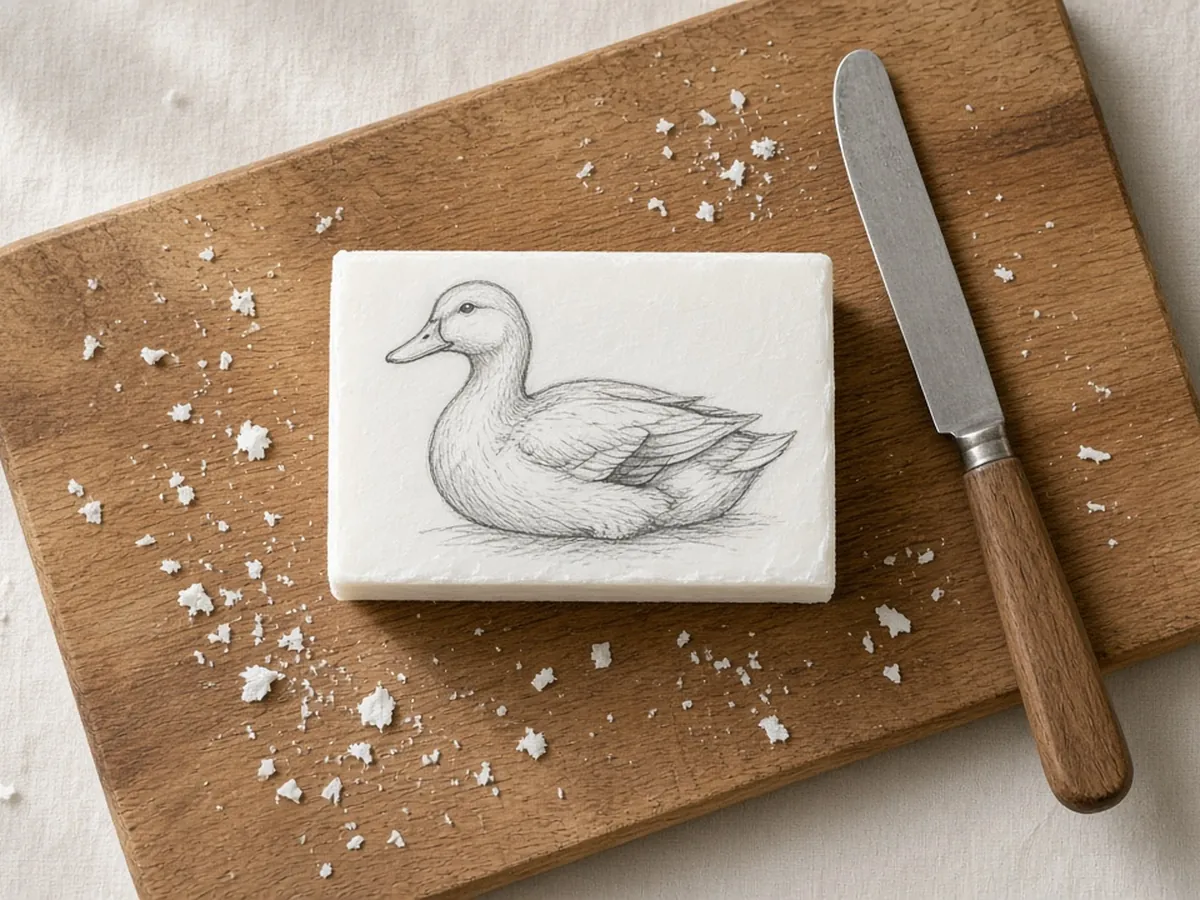
More outlines: printable soap carving templates.
3. Block out the silhouette
Lay the bar flat and shave away the four outside corners first. Work toward the pencil line in short passes, turning the soap at each curve. Stop just outside the mark. The duck should already read from the side before you refine anything. Protect every bridge between bill, head, wing, tail and body.
4. Soften the head and keep the bill broad
Round the forehead and cheek with light bevels, then taper only the underside of the bill. Keep its tip blunt and its join to the head thick. A single shallow line can separate bill from face. Don’t cut a narrow open notch.
5. Add the wing and tail in low relief
On the broad side, bevel around the wing oval so it sits slightly proud of the body. Keep the wing connected along its whole inner edge. Shape the tail as a short raised wedge, not a separate feather or a sharp point.
6. Level the base and stop
Set the duck on the towel. Flatten only the part of the underside that rocks, keeping the body fuller than the base. Round sharp edges, press in one eye with a toothpick, brush away crumbs and check the face, side and end views. Let it air-dry before display.
Finished means: a clear silhouette, a stable base, and no fragile part asking for one more cut.
What makes a soap duck read as a duck
Three relationships do the work: a full body, a smaller rounded head and a bill that projects without becoming a spike. The wing adds a second layer on the side, and the tail points the eye back toward the body. Get those right and you don’t need feet, feathers or a realistic eye.
Turn the bar after each major cut. From the end, the duck should still have real mass, not the thickness of a cookie.
Easy duck soap carving variations
- Seated duck: skip the feet and make a low, rounded belly with a flat underside.
- Duckling: enlarge the head, shorten the bill and keep the tail as a soft bump. This is the easiest version for kids.
- Rubber-duck style: an extra-round head and body, a stubby rounded bill and no wing detail. It’s a cheerful bath-time shape that’s very forgiving.
- Pond profile: one long body, one wing curve and no separate feather cuts.
Rescue plan
| Problem | Fix |
|---|---|
| The bill cracked | Shorten it, round the tip and widen the join to the head. A compact bill still reads as a duck |
| The wing looks flat | Don’t hollow the body. Add one shallow bevel around the wing so a small shadow gives it relief |
| The duck tips over | Flatten a little more of the underside on the low side, or widen the base. Keep the breast and back full |
| The bar is crumbly | Stop deep cuts, choose the broadest version and leave out the eye and feather lines |
More fixes: soap carving problems and fixes.
Bench safety
Work on the towel, keep your holding hand behind the blade’s path and cut away from your body with light pressure. A rounded butter knife is enough; never force a stubborn cut. Keep soap out of mouths and eyes, and wash your hands afterward. Children need an adult who sets up the tools, controls any cutting and stays present throughout. See soap carving safety.
FAQ
What soap is best for a duck soap carving?
A firm, plain, opaque bar with a dry surface and enough width to leave a border around the duck. Test one corner first. A clean curl matters more than the brand name.
How thick should the duck’s bill and wing be?
Visibly thicker than your pencil sketch, with broad connections to the head and body. Thin-looking details are the first to snap, so remove less and round the edges.
Do I need to carve both sides of the duck?
No. Match the outer profile on both sides, then use shallow bevels and one wing plane to suggest volume. A duck that reads well from the side is a successful beginner carving.
How do I carve a rubber duck from soap?
Use the same steps but make the head and body extra round, keep the bill short and stubby, and skip the wing detail. A thicker bar helps it look chunky from the front.
What should I do if the duck tips over?
Find the low side and take a small matching shaving from the opposite underside, or widen the base into a simple flat foot. Don’t thin the body to chase balance.
Can children make a soap duck?
Yes, with an adult actively present who sets up the surface, chooses and controls the tool, and keeps soap and small pieces away from mouths, eyes and pets. The duckling version is the easiest.