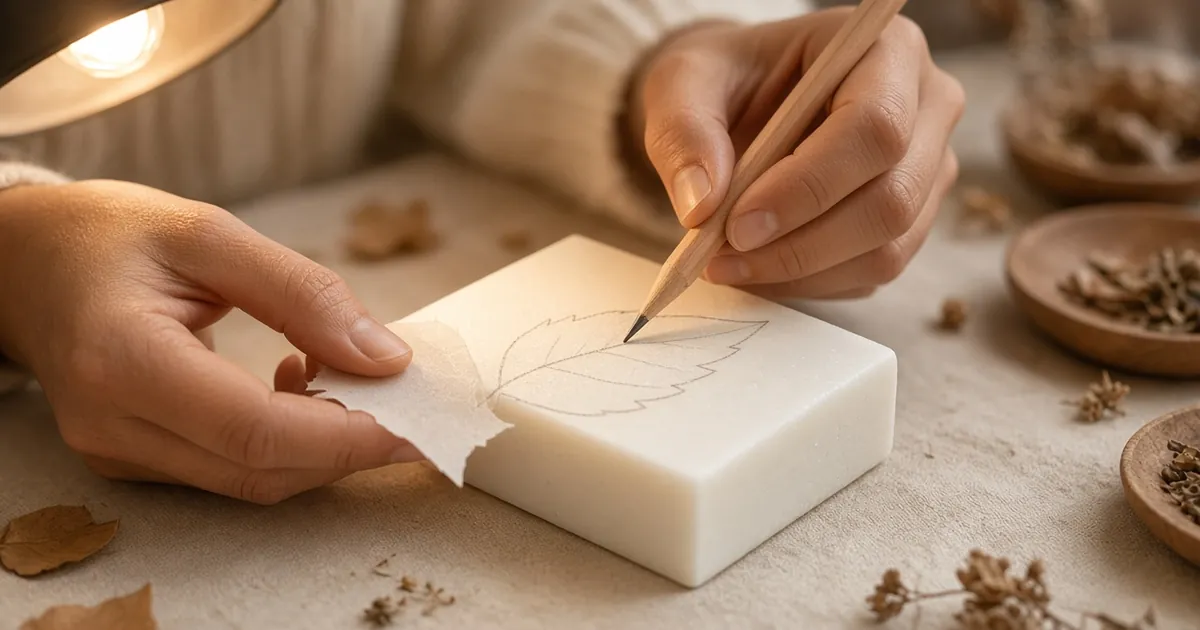
These free soap carving templates are five simple outlines (leaf, fish, heart, flower and star) sized for a standard rectangular bar. Download the US Letter + A4 PDF, print at 100% (“actual size”), and scale the outline to fill about two-thirds of your soap’s broad face. The border you leave is what keeps ears, tails and points from breaking.
A template should make the first decision easier, not make the project smaller. Treat the paper as a map, not a rulebook.
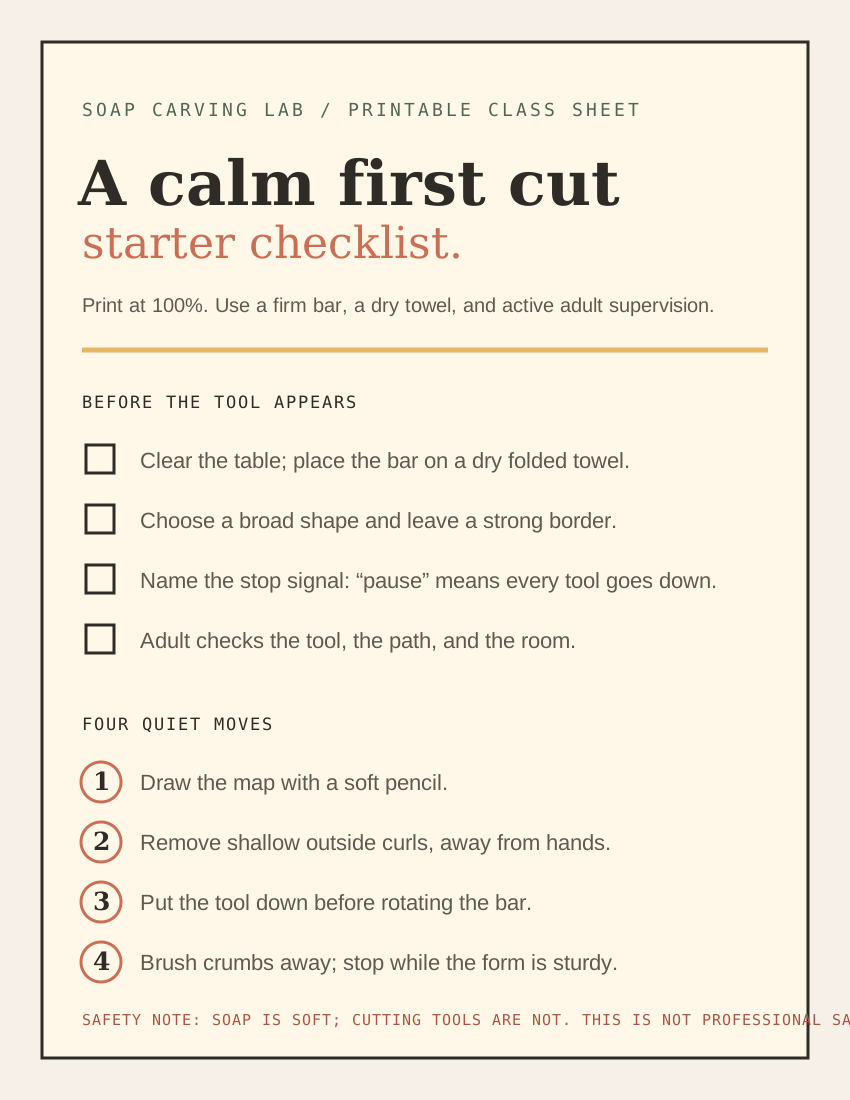
Download the soap carving templates PDF (US Letter + A4) · Class checklist

Choose “actual size” or 100% in the print dialog; avoid “fit to page.” Download the US Letter + A4 PDF.
Each outline suggests a different first skill. The leaf is a long, continuous curve; the fish asks you to protect a tail and keep the body balanced; the heart is forgiving when the two lobes are not identical; the flower rewards a broad center; and the star is best kept low and blunt at its points. Choose the one that matches the bar rather than the picture you wish the bar were.
Which soap carving template should you start with?

Each outline teaches a different first skill. Pick the one that matches your bar, not the picture you wish the bar were.
| Template | Level | What it teaches | Full project |
|---|---|---|---|
| Leaf | Easiest | One long, continuous curve | Leaf soap carving |
| Heart | Easiest | Forgiving curves; the lobes don’t need to match | Soap carving heart |
| Fish | Easy | Protecting a tail and keeping the body balanced | Fish soap carving |
| Flower | Easy | Keeping a broad center under shallow petals | Flower soap carving |
| Star | Easy | Low, blunt points | Simple snowflake (similar scored-line skill) |
| Cat (in the project) | Easy+ | Short, thick ears and a wide tail base | Cat soap carving |
| Turtle (in the project) | Easy+ | Rounding a shell, four sturdy flippers | Turtle soap carving |
The PDF has the first five outlines. Cat and turtle outlines are on their project pages.
How to print soap carving templates at the right size
- Choose “Actual size” or 100% in the print dialog. Avoid “Fit to page.”
- Measure your bar’s broad face and compare it with the outline’s longest and shortest points.
- Scale for the weakest feature. A star point, fish tail or petal shouldn’t end up at the edge of the bar.
- Leave a visible border on every side. Aim for roughly two-thirds of the face.
- Do a test print if your printer tends to rescale. Measure one known dimension and adjust before tracing.
No printer? Copy the outline by hand. Mark a centerline and two outer reference points first so the shape doesn’t stretch, then draw a light pencil box around it to check the border.
How to transfer a template to soap
- Pick the broadest face. Dry the bar, set it on a towel and rotate it until one face offers the most room. On a rounded bar, use the flatter side.
- Trace lightly. Hold the paper still and redraw the outline with a soft pencil, or cut the paper shape out and trace around it. Add a centerline for a leaf or fish if it helps.
- Resize before you cut. If the pattern fills almost the whole bar, redraw it smaller. If it’s tiny, enlarge it. The border is structural material, not waste.
- Clear the corners first. Use a rounded knife to take off the four outside corners in shallow passes. Keep the pencil line until the silhouette reads, then add one detail at a time.
Don’t press through the paper with a sharp point or try to cut along a loose sheet. Once the outline is on the bar, move the paper away so it can’t catch a moving tool.
Rounded bar tip: put a short center mark at each end of the face and connect the template’s centerline between them. Trace the left half, set the tool down, rotate, then trace the right half. If the sides meet unevenly, keep the fuller outline. Symmetry is easier to fix in pencil than after the soap is gone.
Soap carving templates for kids
The templates work well as a drawing-and-shaping activity for children:
- Start with the leaf or heart. They have no thin parts to snap.
- Let kids cut out the paper shape themselves and trace around it with a pencil or toothpick.
- An adult chooses the tools (popsicle sticks, toothpicks or a rounded butter knife), prepares the table and stays present for every cutting session.
- For a classroom, print the class checklist and see soap carving for kids.
Make your own soap carving pattern
- Trace your bar on paper to get its exact outline.
- Inside it, draw your subject as a single bold silhouette, the way it would look as a shadow.
- Thicken anything thinner than a finger: legs, tails, ears, stems.
- Join fragile parts to the body (tail against the side, trunk against the chest).
- Cut it out and trace it onto the soap.
Animals work best in side profile. See animal soap carving ideas for shapes that hold together.
FAQ
Are these soap carving templates free?
Yes. The outlines and the PDF are free to print or copy for personal making, teaching or a group session.
Is there a soap carving patterns PDF?
Yes. The soap carving templates PDF includes US Letter and A4 versions of the leaf, fish, heart, flower and star outlines.
How large should a soap carving template be?
Start at about two-thirds of the broad face of the bar. That leaves a border for the knife and keeps narrow features from becoming fragile.
Can children use soap carving templates?
Yes, as a supervised drawing and shaping activity. An adult should choose the tools, prepare the work area and stay present for every cutting session. The leaf and heart are the easiest starting shapes.
What if my printer changes the size?
Print a small test, measure one known dimension and compare it with the pattern. Adjust the scale before tracing. Once the outline is on the soap, changing size means redrawing it.
Where can I find more soap carving patterns?
Every project page includes its own outline guidance. Start with the cat, turtle, fish or heart, or browse 12 easy soap carving ideas.