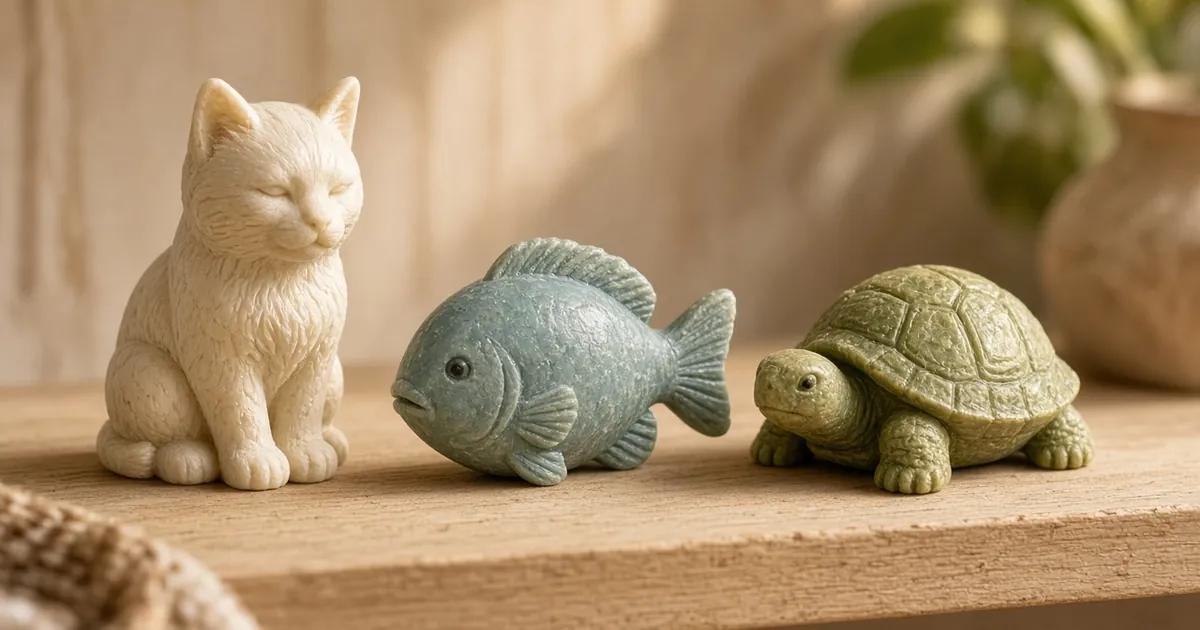
The easiest animal soap carvings are a fish and a turtle: one broad body, a short tail or flippers, and nothing thin to snap. Next try side-profile animals like a duck or whale, then animals with ears (cat, dog, bear), and save long features like an elephant’s trunk or a giraffe’s neck for later. Whatever you carve, keep a thick bridge between every feature and the body. That one rule prevents most breaks.
Below are 16 animal projects, each with a full step-by-step page, ordered from easiest to more involved.
16 animal soap carving ideas, easiest first
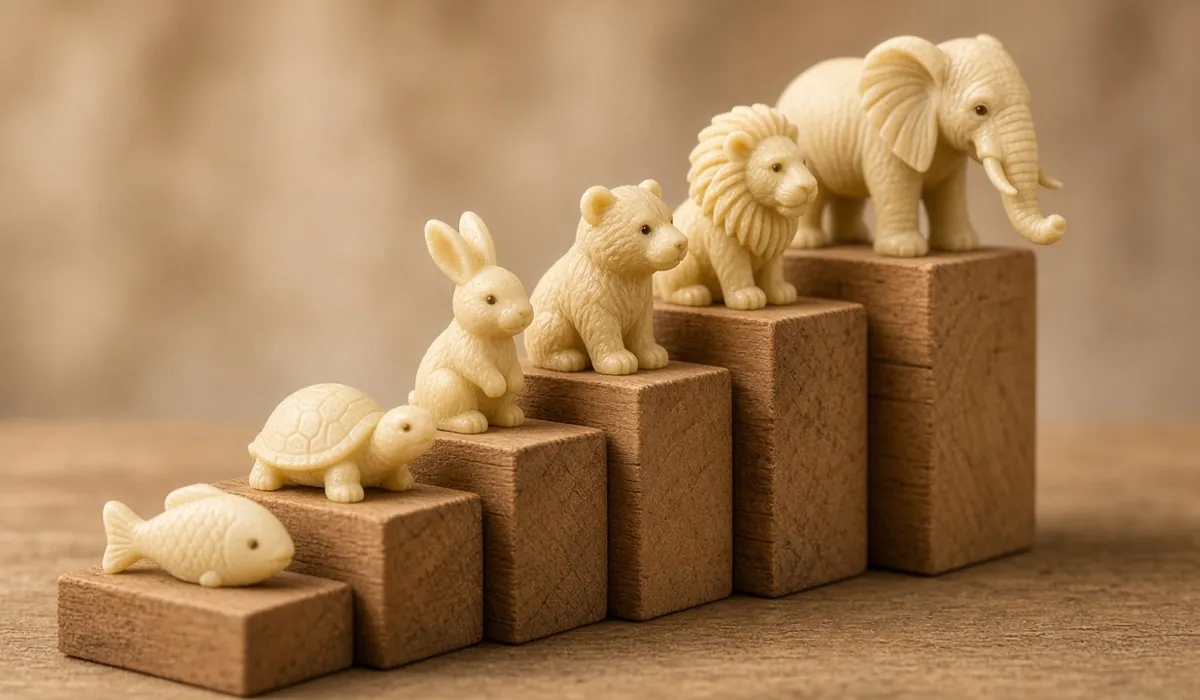
| # | Animal | What it teaches | Level | Time* |
|---|---|---|---|---|
| 1 | Fish | A wide body and a connected tail. The calmest first animal | Beginner | 15 min |
| 2 | Turtle | A low dome shell with four short flippers | Easy | 25 min |
| 3 | Duck | A side profile with a broad bill and wing | Beginner | 35 min |
| 4 | Whale | A full body, connected tail, low fin | Beginner | 35 min |
| 5 | Dolphin | One long connected curve and a protected tail | Beginner | 35 min |
| 6 | Bird | Beak and tail joined to one broad body | Beginner | ~30 min |
| 7 | Cat | Short, thick ears and a wide tail base | Easy | 25 min |
| 8 | Dog | A lifted muzzle and soft, floppy ears | Easy | 30 min |
| 9 | Bear | A round front-facing body, ears and muzzle | Beginner | see project |
| 10 | Owl | A front-facing outline with shallow feather marks | Beginner | 35 min |
| 11 | Butterfly | Mirrored wings on a thick body | Easy | 25 min |
| 12 | Frog | A sturdy squat body with four broad feet | Beginner | see project |
| 13 | Spider | A round body with broad, connected legs | Beginner | see project |
| 14 | Elephant | A wide ear and a short trunk with a generous root | Beginner | 40 min |
| 15 | Giraffe | A long neck kept thick and joined to the body | Beginner | see project |
| 16 | Wolf silhouette | A long muzzle, upright ears and tail on one base | Beginner | 30–40 min |
*Times are the estimates on each project page. Your first attempt may take longer.
For kids: start with the fish, turtle or duckling version of the duck. They have no thin points and adapt easily to rounded tools. See soap carving for kids.
Choose an animal by the body, not the details
An animal in soap starts with its body, not its tiny marks. Look at your reference as a few large shapes. Where’s the widest part? Which feature gives the profile its character? What connects that feature to the body?
- A fish is a body and a tail.
- A turtle is a shell on a low base.
- A cat is mostly a head and two ears.
- An elephant is a big body, one wide ear and a trunk that needs a thick root.
Pick a firm, plain bar and test a spare corner (see the best soap for soap carving). If the bar crumbles, smears or asks for force, choose a broader animal from the top of the list.
The animal rule: protect every bridge
Leave a thick connection between tail and body, wing and body, ear and head, trunk and face. A reference photo may make those joins look narrow, but the bar in your hand needs them wider.
How to carve any animal from soap: 5 steps
- Find the mass. Draw one large shape on the broadest face in soft pencil. Add a centerline for mirrored animals. Leave a border and draw slightly larger than the reference suggests. Need an outline? Use our printable soap carving templates.
- Clear the waste. Take shallow passes around the outside. Remove corners, not character. Leave a visible bridge at every ear, wing, fin or foot.
- Turn the bar. Check the face, side and end views after each major change. The animal shouldn’t become a thin plate from the end, and it still needs a base to rest on.
- Suggest the feature. Add an eye, fin, ear line, wing division or shell pattern with a toothpick. If a mark doesn’t help the silhouette, leave it out.
- Stop with strength. If a point chips, round it into the nearby shape. A short ear can become a rounded ear, and a broken fin can become a wider tail.
Tools for all of this are just a rounded knife, pencil, toothpick and dry towel. See soap carving tools.
Easy design tricks for soap carving animals
- Profiles beat 3D. A clear side view reads instantly. You don’t need to carve every side.
- Join, don’t separate. Tuck tails against the body, keep legs as one block with a shallow line between them, and rest trunks against the chest.
- One texture, lightly. Scales, fur or shell lines go in last and only shallowly.
- Make babies. A duckling, kitten or hatchling has a bigger head and shorter features, which is naturally sturdier.
Make the animal activity safe
Animal shapes tempt people to add thin points, and that’s where a calm setup matters most.
- Adults: choose the bar and tool, demonstrate one short pass and keep sharper blades under direct control.
- Children: broad templates, firm soap, rounded tools and active adult supervision. A child can draw, hold the towel, brush crumbs and make selected shallow marks.
- Cleanup: keep chips on paper or a tray, wash hands after the session and store the carving dry.
Read soap carving safety before a classroom or family session.
FAQ
What is the easiest animal soap carving?
A fish is the easiest first animal because its body and tail stay broad and the profile does most of the work. A turtle is a close second: a low shell with short, sturdy flippers.
How do I carve an animal from soap?
Draw the animal as a simple silhouette, remove the surrounding corners in shallow passes, and keep the body wider than the reference suggests. Turn the bar after each major cut, protect the connections between parts, and add only a few details once the form reads from several angles.
What animals are good for soap carving beginners?
Fish, turtles, ducks, whales and broad dog profiles are approachable because they have large connected masses. A cat or butterfly works too if the ears, wings and body stay thick.
Can children do animal soap carving?
Yes, as a supervised activity: an adult sets up the table, chooses the tools, controls the cutting direction and stays present. Fish, turtle and duckling shapes are the easiest for kids.
How do I keep animal soap carvings from breaking?
Keep tails, ears, feet, wings and fins connected to a broad body, make shallow passes and check the side profile before thinning anything. If a point cracks, round it into the silhouette. More help: soap carving problems and fixes.