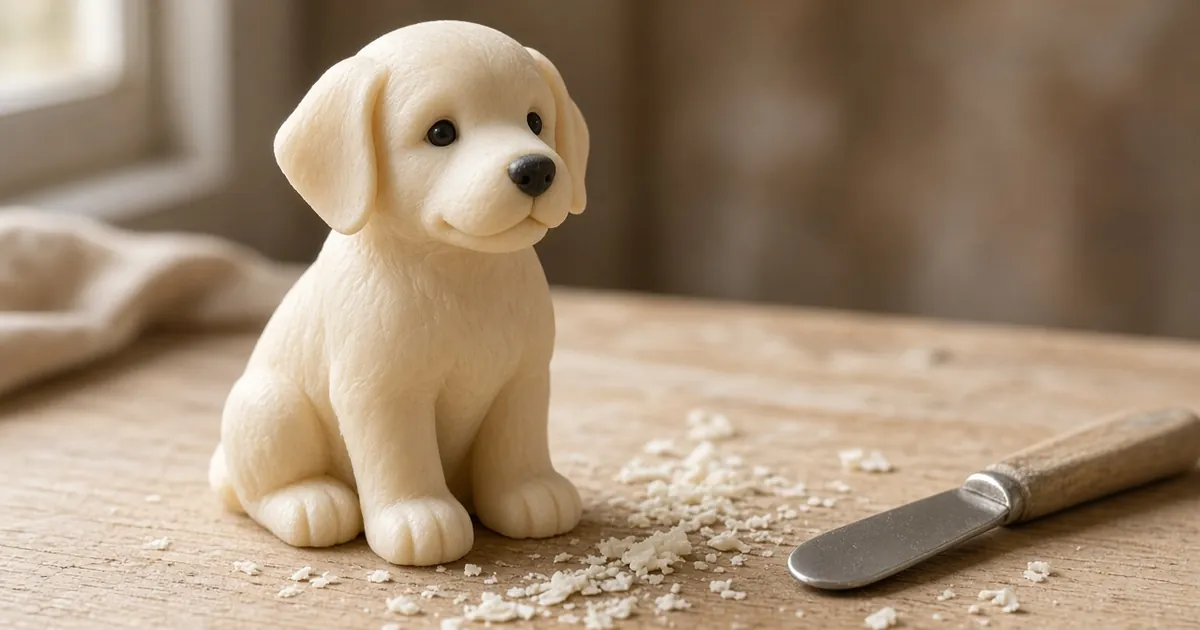
For an easy dog soap carving, draw a sitting dog’s side profile on the broad face of a firm bar, cut away the outside in short passes, round the back, belly and muzzle, then trim one floppy ear and press in an eye with a toothpick. It takes about 30 minutes with a rounded butter knife. Keep the body chunky and the ear and neck roots thick. Those are the bridges that break.
A sitting dog is a friendly second or third animal after a fish or turtle. The ears and muzzle carry the character, so you don’t need tiny realistic detail.
| Project | Level | Time | Soap | Tools |
|---|---|---|---|---|
| Soap carving dog | Easy | ~30 min | One firm, unscented bar | Butter knife, pencil, toothpick, towel |
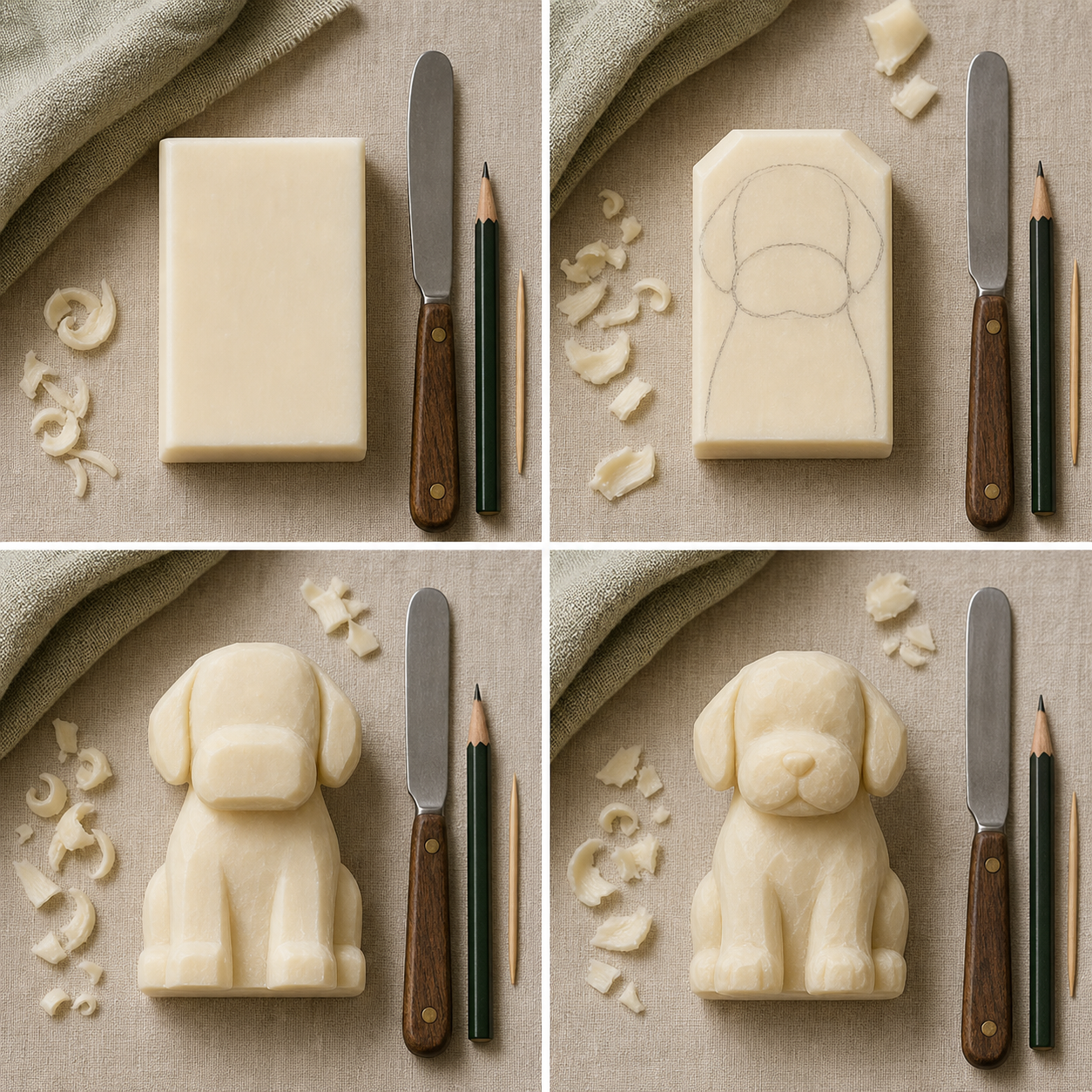
What you need
- One firm bar: unscented, opaque and dry to the touch, with enough width for a sitting profile. See the best soap for soap carving.
- A rounded butter knife: for shallow silhouette and beveling cuts.
- A soft pencil: to sketch the profile before committing.
- A toothpick: for the eye, nose and a light collar line.
- A tea towel: for grip, chips and a soft landing.
That’s the whole kit. More options and home substitutes are in our guide to soap carving tools.
A broad guest-size bar is forgiving around the muzzle and paws. A narrow bar suits a compact puppy. Ridged, heavily layered or damp soap makes the profile hard to judge, so simplify the design if the bar won’t give a clean edge.
How to carve a dog out of soap in 5 steps
Step 1: Give the bar a chance
Choose a dry, room-temperature bar and lay it lengthwise on the towel. Test the knife on a hidden lower edge before you commit to the head. You want a thin curl with a little resistance, not a smear or a cloud of crumbs. Keep the full thickness for now; it gives you something to hold.
Look for: a surface that keeps a clean corner when you press it lightly.
Step 2: Draw a sitting profile
On the broad face, sketch a rounded back, a chest, two tucked front paws and a short muzzle. Add one floppy ear as a soft triangle hanging from the head. Keep the dog inside about two-thirds of the bar, with a finger-width border and a thick base. Draw the neck and ear root wider than feels natural.
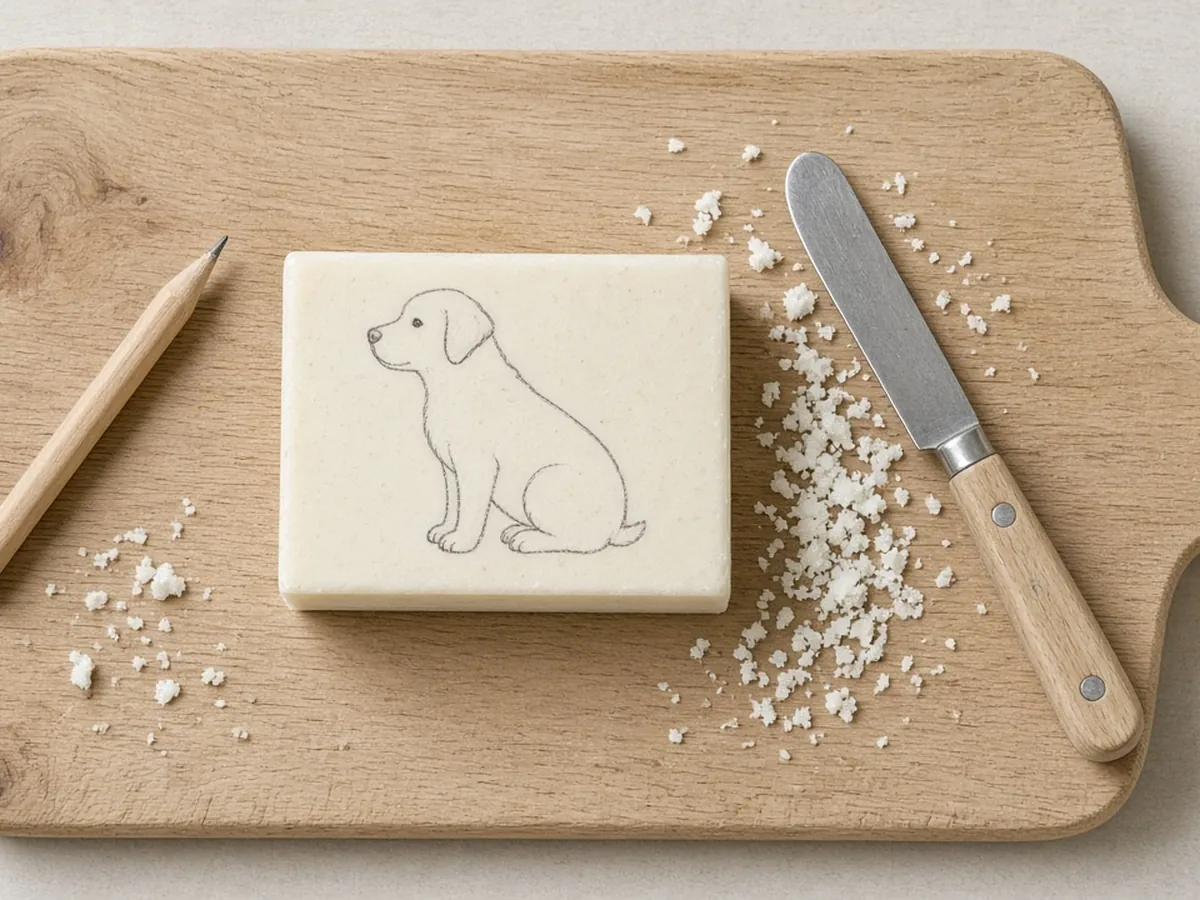
Want more outlines to practice on first? Try our printable soap carving templates.
Step 3: Cut the silhouette in curls
Use the rounded knife just outside the pencil line. Remove the four large corner blocks first, then tidy the back, belly and muzzle with short passes. Turn the soap instead of twisting your wrist, and keep the knife moving away from your fingers. Leave the full thickness until the outline reads as a dog from arm’s length.
Remember: a clear silhouette beats a sharp ear or a perfect paw.
Step 4: Round the body and muzzle
Stand the dog on its edge and bevel the long top and bottom corners to make a back and belly, keeping the center broad. Soften the nose more than the paws, and cut a shallow notch under the muzzle. Check the side view often. The dog should still look solid enough to pick up.
Step 5: Set the ear, eye and stop
Trim the floppy ear into a rounded flap that stays attached along a thick root. Press in one tiny eye and a nose with the toothpick, and add a short collar line only if the neck is sturdy. Set the dog on the table and shave only the high spot if it rocks. Brush away crumbs, soften one sharp corner and stop.
Finished means: the profile reads clearly, the muzzle and ear feel sturdy, and the piece is comfortable to hold.
Read the dog in three shapes
A friendly dog profile works because the torso, head and ear each have a clear job. Let the torso carry about two-thirds of the outline, keep the head rounded rather than pointy, and use the muzzle as a small forward step. The sitting base is part of the design: a broad bottom keeps the dog stable while the chest and back create the pose.
Choose the amount of detail by the bar, not by the picture in your mind. A thick bar can hold a muzzle notch and two tucked paws. A smaller or softer bar should keep one smooth chest and a single eye. If a cut would separate the head from the body, use a shallow line instead. It suggests the boundary without weakening the bridge.
Easy dog soap carving variations
- Sleepy puppy: a short muzzle, a low ear and a rounded back with minimal paw lines. This is the easiest version and the best rescue pose.
- Alert dog: lift the muzzle slightly and make one ear sit higher than the other.
- Long-eared friend: widen the ear flap, but leave its root as thick as the neck. Good for a hound-like look.
- Terrier-style profile: a squarer muzzle and a short upright tail kept tight against the back.
- Lying-down dog: use a long bar on its side, with the chin resting on crossed paws. There’s no tall neck to snap.
Pick one defining feature (ear shape, muzzle or tail) and keep the rest simple. The same five steps cover every variation.
Make it a dog soap sculpture
The steps above make a sturdy profile carving. For a dog you can look at from every side, use a thick bar and think in two views:
- Draw the side view on the broad face and a front view on the end: a rounded head above a pear-shaped chest.
- Block out the side view first, then the front view, tapering the chest toward the head.
- Round a little at a time, turning the dog constantly and taking thin curls from the corners left by both views.
- Keep the ears and tail against the body. An ear lying on the cheek and a tail wrapped around the haunch are far stronger than parts that stick out.
Rescue plan: when the dog loses its shape
A dog can stay charming with a short ear or a wide muzzle. Pause before correcting anything, rotate the bar, and check whether the silhouette still says “dog” from a little distance. Fix the largest shape first (the back, chest or muzzle), not a tiny face mark.
| Problem | Fix |
|---|---|
| The ear cracks | Round it into a smaller flap and leave it attached at a thick root |
| The muzzle feels thin | Stop carving under the nose. Widen the cheek and let the muzzle stay broad |
| The body looks flat | Bevel only the back and belly edges. A small highlight makes the volume visible |
| The dog won’t sit flat | Leave the bottom third mostly intact, test it on the table and shave only the high spot that rocks |
| A big piece breaks away | Don’t glue or wet the break. Shorten the ear or muzzle and turn the pose into a sleepy puppy |
More fixes for cracks and smears: soap carving problems and fixes.
Bench safety
Use a rounded butter knife, keep the cutting edge moving away from your fingers, and work on a stable towel rather than in your palm. Take a break when your grip gets tired. Soap chips aren’t food: keep them away from children and pets, then wash your hands and wipe the table. Children need an adult who sets up the tools and stays present throughout. Full guidance: soap carving safety.
FAQ
What soap is best for a dog soap carving?
A firm, opaque bar that keeps a clean corner when pressed lightly. Unscented soap is easiest for a close session. Avoid wet, sandy, waxy or crumbly bars.
How do I keep the soap dog sitting flat?
Leave the bottom third mostly intact while you shape the back and chest. Test it on the table before adding paws, then shave only the high spot that makes it rock.
Can the dog’s ears be different sizes?
Yes. A slightly uneven pair often gives the dog more personality. Keep both roots thick, then let one ear fold forward or sit a little lower.
How do I choose a dog breed or pose?
Start with the bar’s proportions. A broad, short bar suits a sitting puppy or round-eared dog, while a longer bar can carry a stretched back or longer muzzle. Pick one defining feature (ear shape, muzzle or tail) and keep the rest simple.
Is a dog soap carving good for beginners?
Yes, especially as a second animal. A fish or turtle is simpler, but a sitting dog has a broad, connected body. Only the ear and muzzle need care.
When is the dog finished, and how do I keep it?
Stop when the profile reads clearly and the muzzle and ear feel sturdy. Brush it clean, let it air-dry overnight and store it somewhere dry. See how to store and display a soap carving.
Keep making small forms
- Cat soap carving: the same profile logic with pointed ears (25 min)
- How to carve a bear from soap: another rounded, eared animal
- How to carve a wolf silhouette from soap: the dog’s wilder cousin
- A pocket fish: the easiest warm-up (15 min)
- Animal soap carving ideas for beginners: choose your next creature