01
Start small
Center mark
Draw a 12–15 mm circle on the clean top face. Trace it with a toothpick or knife tip, but do not dig a trench. Leave a flat island for the tight center.
A field guide for small, good things
PROJECT / 03 Botanical study
Make a recognizable rose in one firm soap bar, working from the center out. The promise: three shallow turns, a supported edge, and enough time to notice how the light changes across the petals.
This is an intermediate relief project, not a deep sculpture. You are carving height differences into one flat face, so the rose stays broad and sturdy. Work slowly enough to keep the rings readable.
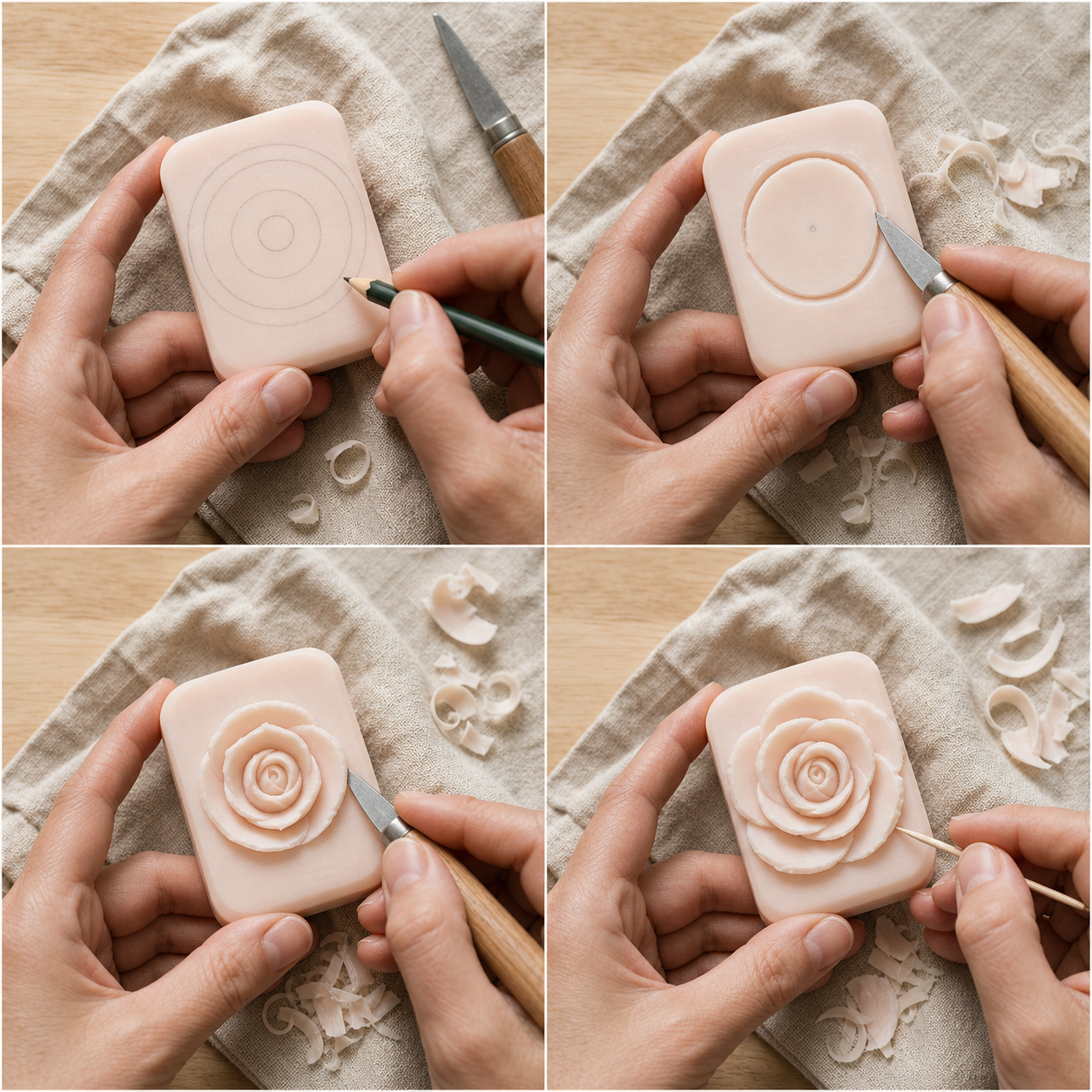
01 Before the first line
Rose work rewards a clean surface and steady grip. Set everything out first, so the flower gets your attention.
02 The four marks
Follow the four-panel diagram above as your map. Keep the bar flat on the towel, make each cut shallow, brush away chips, and check the side profile before the next layer.
Start small
Draw a 12–15 mm circle on the clean top face. Trace it with a toothpick or knife tip, but do not dig a trench. Leave a flat island for the tight center.
Make the first drop
Draw a ring 4–6 mm outside the center. Set the rounded knife edge outside the line and make short, curved passes, removing roughly 1–2 mm. Turn the soap so your wrist stays quiet.
Widen the shadow
Add the third outline farther out, keeping the space broad. Lower it just enough for a visible shadow. Perfect circles are not the goal; an uneven turn can look like a petal folding over another.
Protect the silhouette
Mark five or six broad scallops around the outer ring, then remove tiny notches outside each curve. Keep the bases thick and connected. Soften corners, sweep away chips, and stop when the rose reads from a distance.
03 A useful constraint
The flower needs small ledges that catch different amounts of light, not deep petals.
Three layers are enough because the eye reads the rose as a sequence of turns: a tight center, a middle fold, and an outer edge that opens into the surrounding bar. Each step creates a new shadow. If the rings are too close together, they merge into a target; if they are too deep, the soap loses the broad, quiet face that makes this project sturdy.
Keep the center slightly above the visual middle of the bar if the top edge is uneven, and leave a generous outer border beneath the final scallops. A 1:1.5 center-to-outer-ring relationship is a useful starting point, but spacing matters more than measurement. Rotate the bar and check the profile after every ring. The side view tells you whether you are building steps or accidentally hollowing a bowl.
Material choice changes the way the shadows behave. Firm, opaque soap gives a clean ledge and makes pencil marks easy to follow; a translucent or soft bar may blur the relief sooner. Test the underside before committing to the face. If the curl comes away in crumbs, shorten the next pass and widen the ring rather than pressing harder.
04 Bench questions
Most problems signal that you need less depth, wider spacing, or a better grip.
It should hold a clean corner when pressed lightly, without feeling brittle or glassy. A plain, opaque bar is a good start. Test one shallow curl underneath: if it smears, choose firmer soap; if it splinters, use less pressure.
Only deep enough to change the light. Start near 1 mm and check the side profile. Three modest levels read more clearly than one deep spiral and keep the outer petals strong.
Stop and brush away the loose chip. Round the break into a wider scallop or connect it to the next petal. Do not glue or wet it; changing the silhouette is the cleanest repair.
Yes, if it is firm. Color can make the relief beautiful, but pale soap makes shadows and pencil marks easier to see. Unscented soap keeps the session simpler for fragrance-sensitive makers.
No. Keep the three layers on one broad face and leave the back flat enough to support the flower. A single-sided relief gives you a stable base, makes the shadows easier to read, and leaves more material under the outer petals.
05 Next on the shelf
When the rose is dry, study its profile. Then choose a project that asks for a different kind of attention.
View the full project shelf ↗