Editorial check: 2026-09-25 · Written for general education by Soap Carving Lab. Tools can cut; adults should actively supervise children. This is not professional safety advice.
22 Object / beginner project
Carve a seashell from soap.
A seashell soap carving reads through its broad fan before any small detail. Keep the hinge, ribs and scalloped rim joined to the bar; a few shallow grooves give the form rhythm without asking thin soap to carry the whole design.
Begin the six quiet stages ↓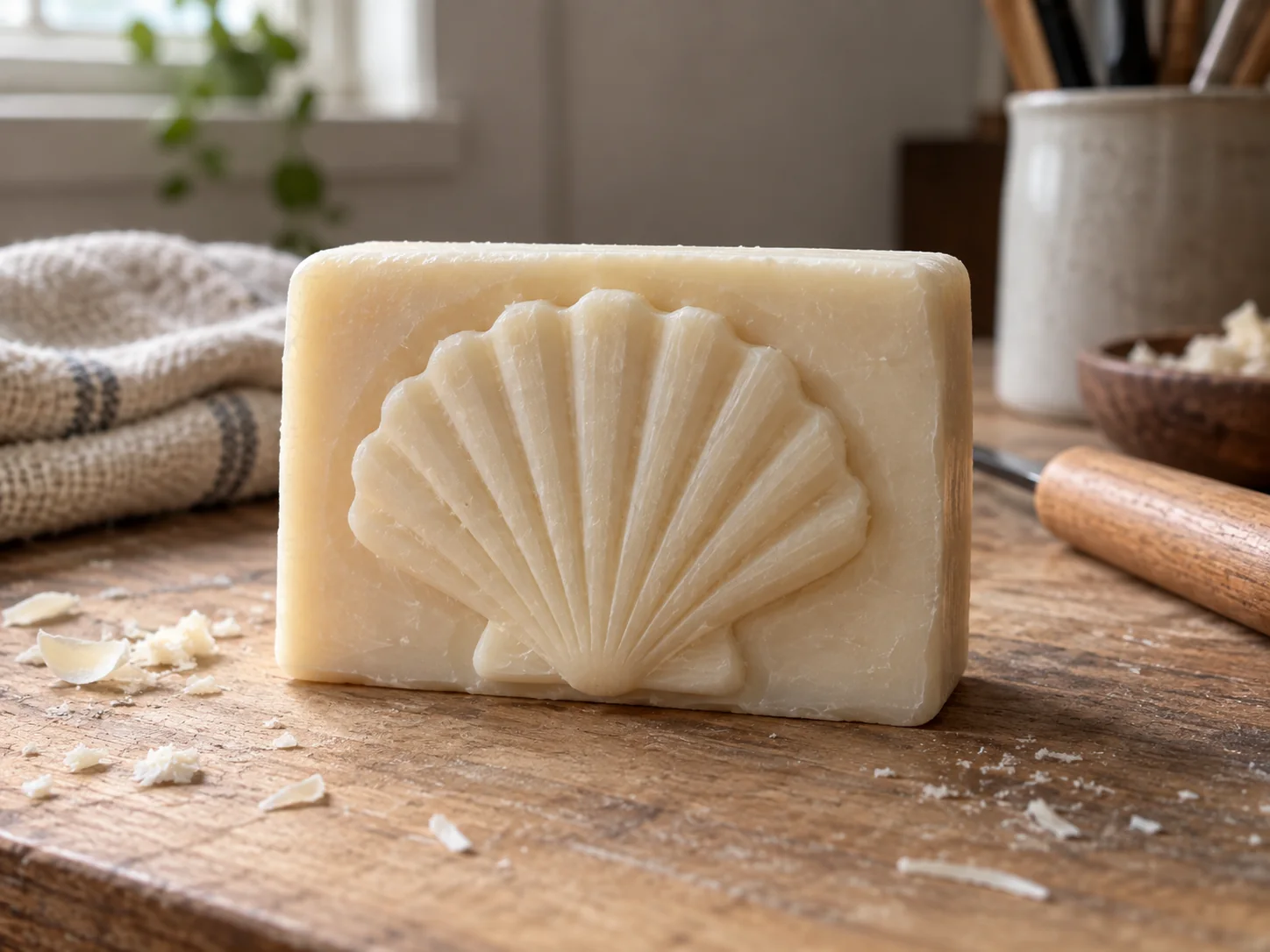
01 Set the bench
Give the shell a bar with room.
Choose the broadest flat face and leave a clear margin around the design. A shell does not need a hollow back or separate ribs: this project lowers the area around one connected fan. Review the soap selection guide and safety guide before you begin.
- 01One firm, plain bar
Pick an even face that gives the fan enough width.
- 02A soft pencil
Map the hinge, fan and rim lightly so you can simplify them.
- 03A rounded butter knife
Lower the background with short, controlled curls.
- 04A toothpick or wooden skewer
Score shallow ribs without cutting through the bar.
- 05A folded tea towel
Keep the bar from skating and catch soap curls.
02 Six quiet moves
Let the shell open.
Turn the bar instead of bending your wrist. Lower the background first, then add only enough lines for the eye to read a fan. The shallow-cut technique guide explains how to keep each pass controlled.
- 01
Bar / orient
Choose the broad face.
Dry the soap and rest it on the towel. Find the broadest smooth face and leave an even border around it. A bar that rocks needs to be repositioned before you draw; do not steady it by placing fingers in the path of the tool.
- 02
Pencil map / fan
Draw a hinge and a wide rim.
Mark a small hinge near the lower center, then draw a fan that widens toward the top. Use a few soft scallops rather than many pointed lobes. Keep the hinge attached to the bar and make the outside line broad enough that a shallow cut can follow it.
- 03
Waste / lower
Lower the soap around the fan.
Start outside the outline and remove thin curls from the background. Work around one side, rotate the bar, then work around the other. Leave a low, continuous border at the rim; do not cut a trench that isolates the fan from the bar.
- 04
Rim / soften
Clarify the scallop without thinning it.
Use short passes to round the outer edge and separate broad lobes. Keep each dip shallow and each high point wide. Check the silhouette from above after every few cuts. If one scallop looks uneven, smooth the neighboring curve instead of making a narrow pointed tip.
- 05
Ribs / suggest
Add a handful of shallow grooves.
Begin near the hinge and draw short grooves toward the outer rim. Leave plenty of soap between lines and stop before each groove reaches the edge. A few unevenly spaced ribs can suggest the shell's fan; a dense set of deep cuts makes the relief fragile and harder to read.
- 06
Surface / rest
Inspect the face and let the bar rest.
Brush away loose curls and look at the carving straight on and from the side. The hinge should remain attached, the rim should feel broad, and every groove should be a surface mark rather than a through-cut. Leave the bar on the towel to dry before handling it again.
Form note / fan-shaped relief
Use the outer line to tell the story.
Seashell soap carving works best when the viewer can read the broad fan before noticing its grooves. Keep the lower hinge compact, open the outline gradually and let the rim make a gentle scallop. You are lowering the background around a connected raised form, not trying to hollow a real shell out of a bar.
Leave the left and right sides slightly different if that helps the shell feel hand-drawn, but keep the major ribs clear. A simple outline also helps this project stay distinct from a leaf: the shell spreads outward from one hinge, while a leaf narrows toward both ends and uses a central vein. For another natural form, try the soap leaf relief; for a shape with a stronger side profile, see the beginner fish project.
One focused example / rib spacing
Make every line leave room.
Before scoring the soap, draw two or three trial lines on paper. Let them start near the same hinge but spread toward separate parts of the rim. The fan should still read if you remove half of the pencil marks; that is a useful sign that the outline is doing enough work.
- Mark the hinge and the center rib first.
- Add a small number of neighboring lines, with wider gaps where the soap face narrows.
- Use the rounded point to score lightly, then brush away crumbs and inspect the surface.
- Stop if a rib begins to flex, crumble or look like a thin fin.
This is a shallow relief exercise, not a full three-dimensional shell. Keep the back and the hinge supported by the bar.
03 Rescue plan
Keep the shell whole.
If the outline starts to feel fussy, pause and look at the large shape again. The problem-solving guide has more ways to recover an uneven surface.
- The fan looks like a leaf.
- Widen the upper rim, make the hinge more central and reduce any long center vein. Let the scalloped edge and separated ribs identify the shell.
- The lobes look spiky.
- Round the peaks and lower only the shallow valleys. Do not cut long channels down each side of a point.
- The grooves are too deep.
- Stop scoring and simplify the remaining ribs. Keep the neighboring surface high; do not thin the ribs to make one groove look darker.
- The carving feels too flat.
- That is still a valid relief. Lower one small background area evenly or add a single shallow side line, but keep the shell attached to the bar.
05 Five useful answers
Questions from the towel.
How do I make a seashell soap carving?
Draw a broad fan on the face of a firm soap bar, lower the background in shallow passes and leave a strong outer edge. Add a handful of shallow grooves from the hinge toward the scalloped rim, then stop before the ribs become thin.
What tools do I need to carve a shell from soap?
A firm bar, soft pencil, folded towel, rounded butter knife and toothpick are enough for this beginner relief. Use only tools you can control and follow the soap-carving safety guide.
Should the shell be carved all the way through the soap?
No. Keep it as a low relief attached to the bar. A raised fan with shallow grooves is easier to support than detached shell ribs or a thin outline.
How do I keep the shell grooves from breaking?
Make each groove shallow and leave soap between neighboring lines. Keep the hinge and outer rim broad, and widen a groove rather than thinning the raised rib beside it.
Can a child try this soap carving?
Children need active adult supervision from setup through cleanup. Use a stable table and rounded tools, keep sharper blades under direct adult control, and stop if the soap slips or a cut needs force.