Petals disappear
Lower the background with one broad pass outside the outline. Do not deepen every valley; the contrast between levels should do most of the work.
A field guide for small, good things
Botanical project / easy flower carving
Editorial check: 2026-08-31 · Written for general education by Soap Carving Lab. Tools can cut; adults should actively supervise children. This is not professional safety advice.
07 Project / Botanical · Easy
Try soap sunflower carving as a gentle relief project: start with a plain bar, draw a generous flower, and remove the soap around it until the petals catch a shadow. The result is graphic.
Promise In 30 minutes, you will have a flat sunflower relief with sturdy petals, a raised center, and enough character to look handmade.
Make the first mark ↓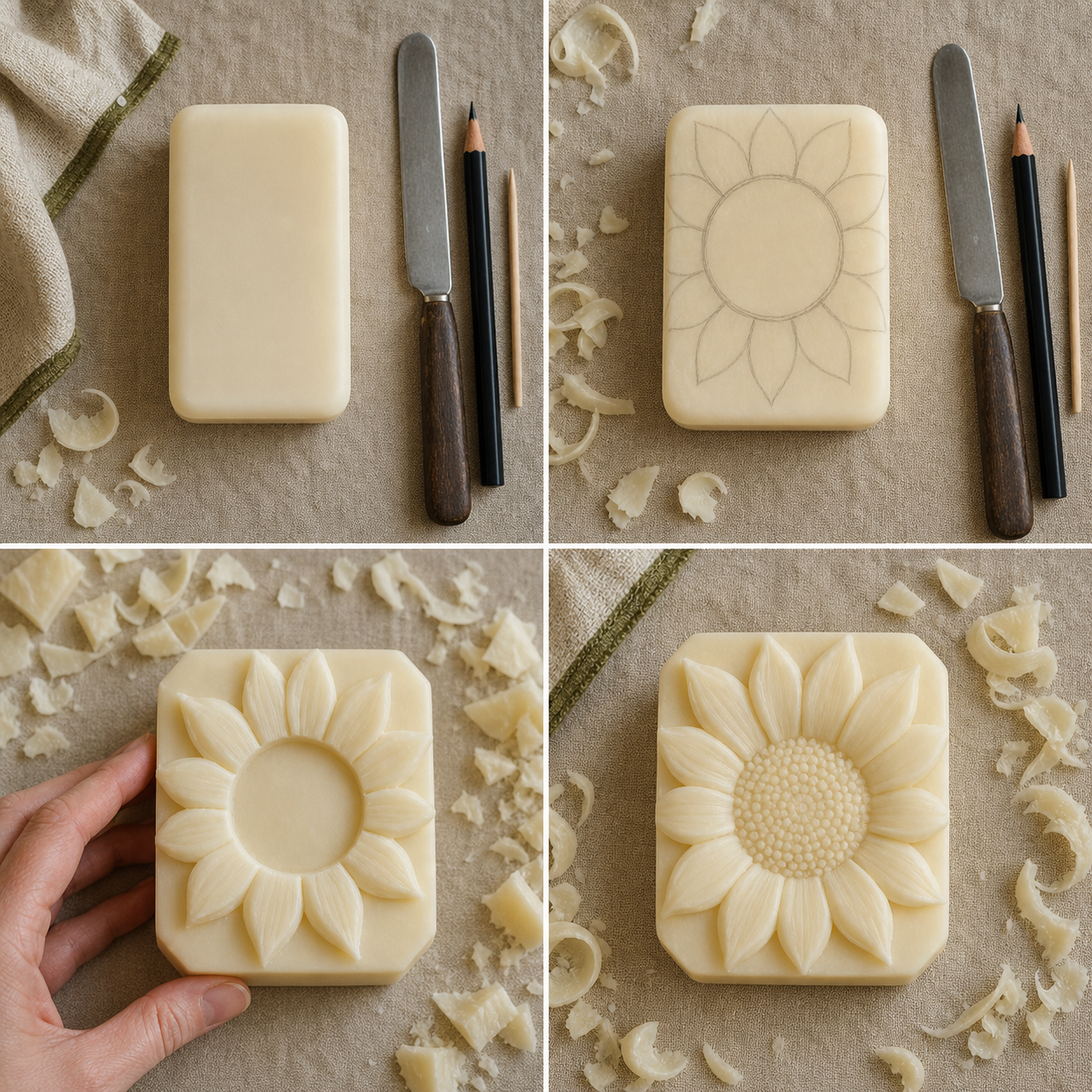
01 Gather / settle
Choose a dry, room-temperature bar with a broad, smooth face; pale or unscented soap keeps the pencil map easy to read. Put the towel on a stable table.
Test one shallow curl underneath before drawing the flower. The soap should give a little resistance and leave a clean shaving. If it powders, shorten the petals and lighten your hand; if it smears, wipe the face dry before continuing. A broad bar is worth choosing here because the outer rim is part of the support, not wasted space. Color can add warmth, but a pale surface makes the relief easier to read while you work.
A pale, unscented bar with one wide flat face.
Use the blunt edge for the relief and shallow bevels.
Map the center, outer circle, and petal tips lightly.
Add seed marks and clear crumbs from narrow grooves.
Keep the bar steady and collect the dry curls.
02 The four flower passes
Move from plain bar to raised flower, then add only marks that help it catch light.
Plain bar / draw the map
Set the dry bar broad face up on the towel. Find the face’s center and draw a coin-sized circle for the seed head. Surround it with 10–12 wide petals, leaving a thumb-width margin at the edge. Keep the tips rounded; a generous map is easier to carve.
Leave: a solid rim around the flower.
Lower the background
Use the rounded knife to remove soap outside the sunflower outline. Work in short, shallow passes from the outer edge toward the pencil line, turning the bar instead of twisting your wrist. Lower the background by a few millimeters while keeping the flower face and outer rim intact.
Aim for: a low field around a raised flower, not a deep trench.
Define the petals
Score each valley from the center outward, stopping before the tip. Bevel one side of every petal with a light scoop, then turn the bar and match the other side. Press a small shallow dish into the center with the knife or toothpick; leave a raised ring between disk and petals so the relief has a clear shadow.
Protect: the sturdy bases where petals meet the center.
Finish the relief
Use the toothpick to add a few radiating seed marks inside the center, then soften sharp petal corners with the knife’s rounded edge. Do not chase identical lengths: shorten a weak petal, widen a narrow valley, and let the rest follow. Sweep away dry crumbs and stop when the silhouette reads without extra decoration.
Finish: when the shadow does the talking.
Form note / radial rhythm
A sunflower reads as a graphic relief through radial rhythm: one strong center, a ring of broad petals, and a quiet field around the edge. The center should be large enough to hold its shape—about a third of the flower’s width—while the petals remain wide at their bases. A shallow drop around the silhouette creates more convincing depth than a narrow trench between every ray.
Let the bar decide the count. Ten or twelve petals suit a broad face; a smaller bar may look better with eight or nine. Keep a solid rim outside the tips, and stop each valley before it reaches the center so the flower stays joined. If the ring feels crowded, remove a petal rather than thinning all of them. The strongest version is the one that still reads when the bar is turned in the light.
03 When the bar answers back
Sunflower relief is about depth control. If the first pass feels muddy, pause before carving harder. Clean the face, compare the raised flower with the background, and make one adjustment at a time.
If a seed mark wanders, leave it and adjust the surrounding field instead of chasing it with a deeper line. Brush away loose crumbs, rotate the bar, and make the next cut broad enough to restore the overall rhythm.
Lower the background with one broad pass outside the outline. Do not deepen every valley; the contrast between levels should do most of the work.
Stop the seed marks and check the bar. If it is soft, smooth the center and keep a simple raised ring. A clear disk is better than fragile detail.
Use your strongest petal as the reference. Adjust the background around it, rather than trimming every petal to chase exact symmetry.
05 Questions from the bench
Choose a firm, pale, unscented bar with a broad face. It should leave a clean curl when tested. Very soft, layered, or transparent soap can smear and make the shallow background harder to read.
Ten to twelve broad petals are plenty for a graphic flower. Fewer makes the silhouette bolder; more makes it busier. Keep the petals wide at the base and rounded at the tips so the soap stays sturdy.
Lower the background only a few millimeters, just enough for the raised flower to cast a shadow when you tilt the bar. Deeper trenches weaken the rim and make the petals look cut apart rather than joined.
Yes, but keep it decorative while the details are crisp. Let it air-dry overnight on the towel, then store it somewhere dry if you want to keep the relief. Water will slowly soften the petals and center.
Yes. Keep the raised center and shallow background, then use eight or nine wider petals with rounded tips. A smaller center makes the flower feel lighter; a larger one keeps it closer to a sunflower. Draw the full ring first and leave the rim intact so the alternative shape stays sturdy.
06 Keep making
If you liked a strong silhouette, stay botanical or switch to an animal that asks for softer rounding.